The History of Encryption. The Confrontation Between Encryption and Intelligence Services.

This course does not claim to be a textbook, and frankly, I am too lazy to delve into the depths of history and methodology, but not in the case of encryption. First of all, it is interesting, and secondly, it is useful, as there are still people today who believe that by replacing letters or words, they securely encrypt information.
Encryption has been known to humanity since the times of the Roman Empire. The Roman Emperor Gaius Julius Caesar, even before our era, when writing an important message, would replace a letter in the original text with another letter shifted 3 characters to the left or right in the alphabet. If enemies intercepted the encrypted message, they could not read it, likely assuming it was some unknown language. This type of encryption is known as the Caesar Cipher and belongs to the group of substitution ciphers, the common essence of which is the replacement of one symbol with another.
Let’s consider the operation of the Caesar cipher with a "live" example. Before you is the alphabet. The first row is the regular alphabet, below it is the alphabet shifted by three characters.
а б в г д е ё ж з и й к л м н о п р с т у ф х ц ч ш щ ъ ы ь э ю я
g д е ё ж з и й к л м н о п р с т у ф х ц ч ш щ ъ ы ь э ю я а б в
For example, the word anonymity, encrypted with the Caesar cipher, looks like this: грсрлпрсхя. This method of encryption is very easily decrypted by simply trying all possible shifts. Even in the times after the birth of Christ, it was not considered secure. More sophisticated methods of substitution came to replace the Caesar cipher, where letters were replaced with symbols.
It would seem, how to crack a cipher where letters are replaced with unknown symbols? Try to guess by substitution? But in encrypted messages, popular words were replaced with a single symbol, leaving no chance for substitution.
This is how Mary Stuart, imprisoned in Sheffield Castle, exchanged messages with Anthony Babington, discussing a conspiracy and the assassination of Elizabeth. Here is a fragment of that letter.
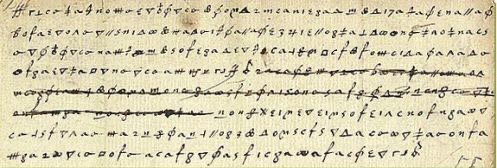
But Elizabeth's counterintelligence service, led by Francis Walsingham, intercepted the letter, and Elizabeth's best cryptanalyst, Thomas Phillips, easily decrypted it. How did he manage to do this? Frequency analysis.
All letters occur in the language with different frequencies. For example, in the Russian language, the letter "о" accounts for 11% of all letters, the letter "р" is about 5%, and the letter "ф" is only 0.26%. Accordingly, it is necessary to simply establish the percentage of usage of symbols in the text, and one can assume which letter a particular symbol will replace; then it will take a little time for substitution and hypothesis testing. This is frequency analysis. It works only in relatively long texts, and the longer the text, the more effective it is.